
Continued...
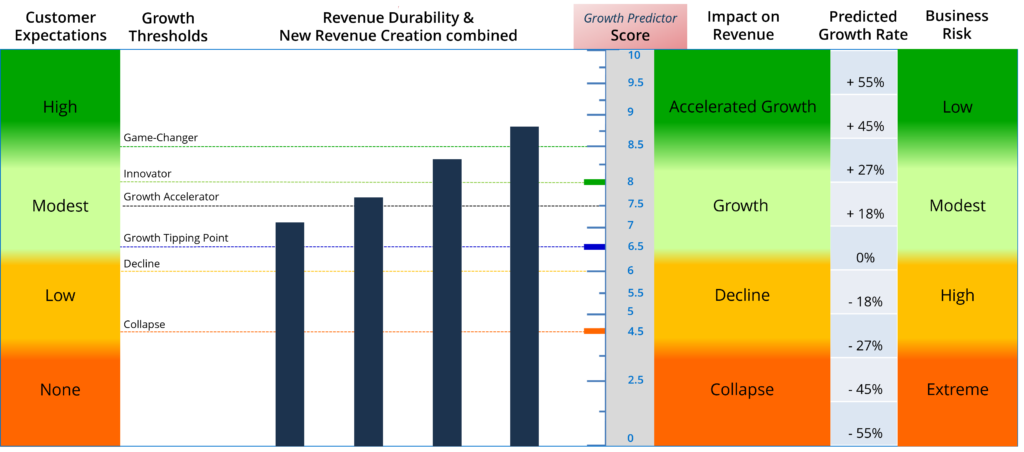
Revenue Durability and New Revenue Creation Capacity measures are combined to form a company’s Growth Predictor Score. From this score the likely future revenue and growth rate over the next 24 months can be predicted. See illustration below.
Predicting Growth Thresholds
Growth thresholds are based on Growth Predictor’s stringent, standardized predictive scoring system. The score range of 1-10 applies a high standard which means CEOs can have confidence in their company’s growth trajectory. Growth thresholds are identified as:
Game-Changer (8.5)
Innovator (8)
Growth Accelerator (7.5)
Growth Tipping Point (6.5)
Each threshold represents a measurable step-change in a company’s ability to consistently convert opportunities into revenue growth. Predicted growth rates are assigned to each growth threshold. This provides an objective measure of where your organisation sits on its growth curve and what actions are required to reach the next stage. It provides you with an additional framework for value creation assessment and exit timing decisions.
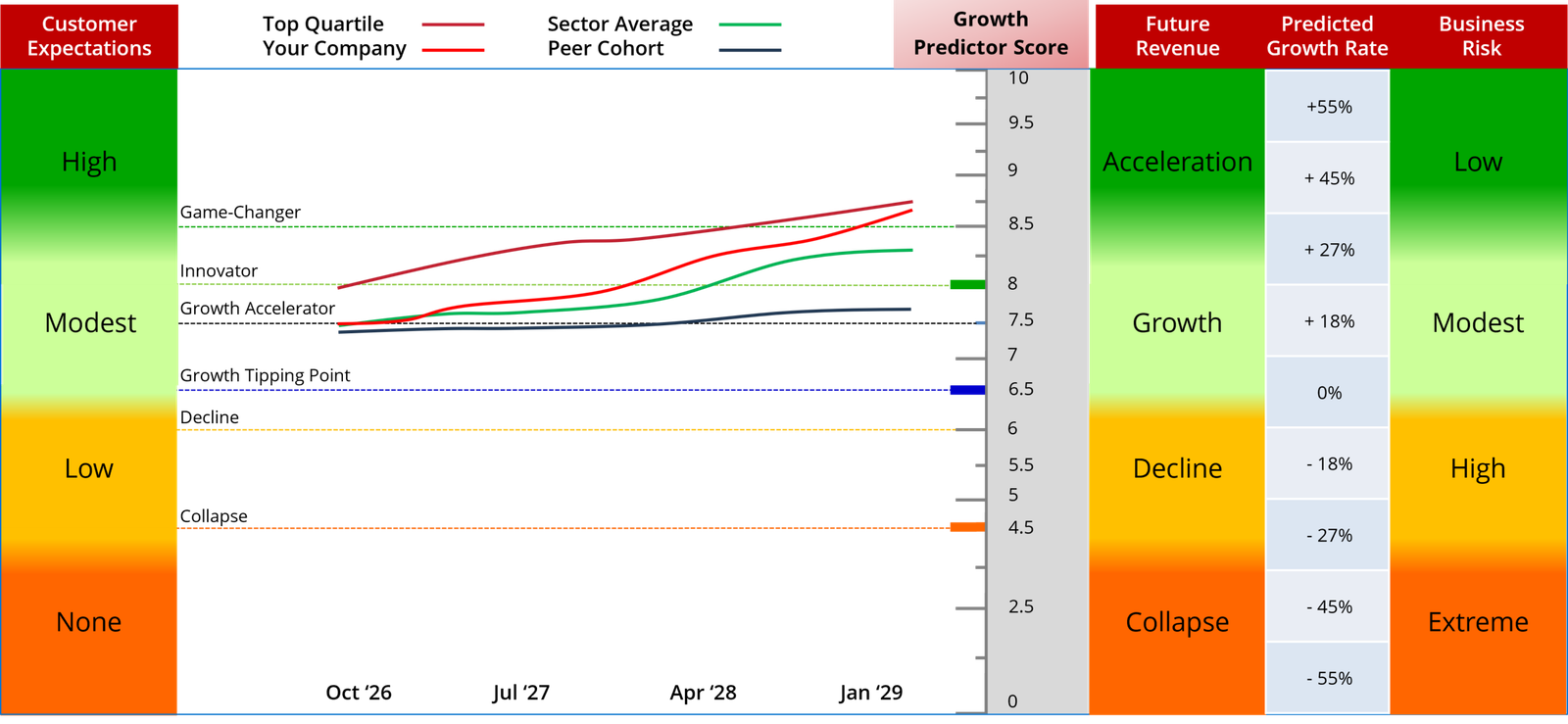
Growth Predictor Index
The Growth Predictor Index measures your a company relative to sector performance, peer cohorts, and top-quartile benchmarks providing a forward-looking view of your competitive growth position.
Background
Alpha Initiative Metrics were developed from observing and measuring high growth in multi-sector enterprises from three decades of advisory work. These observed patterns have been formalised into proprietary predictive models. Growth rate predictions align with realised growth rates achieved by advisory clients with ~90% accuracy.
View the Alpha Programme and timetable here.
The Alpha Advantage provides leaders, for the first time, with a predictive view of their business. The power of the Alpha Advantage is that it is applicable to every business, is measurable, and every person working in a business can add to it.
It delivers accelerated growth performance and competitive positioning in markets where customer expectations and competitive dynamics are evolving faster than traditional decision-making models can respond.